
Background
The implementation of Individual Service Level (ISL) data is ongoing, with CalMHSA receiving guidance from DHCS on an ongoing basis. This protocol will be updated as new guidance is received.
The launch of the Individual Service Level (ISL) encounter reporting system marks a significant advancement in California’s Behavioral Health Transformation efforts. ISL reporting provides a unified, statewide view of non‑Medi‑Cal behavioral health services delivered directly to clients by county behavioral health systems and provider networks. ISL reporting is a BHSA‑mandated requirement and applies exclusively to services not reimbursed by DHCS through Medi‑Cal.
ISL reporting will give counties improved insight into the scope, quality, and consistency of behavioral health services across California. Counties can use the system to access real-time feedback on data quality and validation issues and may choose to submit data through either a Fast Healthcare Interoperability Resources‑compliant Application Programming Interface to support semi‑automated submission, or the system’s full‑featured software, which enables comprehensive data management.
Reporting
Counties must begin reporting ISL encounters for services delivered on or after 1/1/27. Counties must submit ISL encounters annually, no later than 90 days after the end of the fiscal year. This means that the first reporting period will only include 6 months of data, and the report for that data period will be due to DHCS by 9/29/27.
Counties may document ISL encounters in SmartCare prior to 1/1/27 for testing. DHCS will not utilize data submitted during 7/1/26 – 12/31/26 for county performance measures or monitoring.
ISL reporting is different from the Behavioral Health Outcomes, Accountability, and Transparency Report (BHOATR), which is a different report due under the Behavioral Health Services Act (BHSA). This protocol only covers ISL related items. A protocol on the BHOATR will be developed as more information is provided by DHCS.
When reporting ISL data to DHCS, there are certain fields that DHCS allows to be NULL or unknown. However, SmartCare, like most EHRs, does not allow certain items to be NULL or unknown This means that the ISL report created out of SmartCare will generally not include NULL/unknown items. Some examples include:
- The service date for an inpatient service
- All services require a service date in SmartCare.
- The client’s date of birth
- As this is a key identifier, all clients require a date of birth in order to be created as a client in SmartCare. Not including a date of birth would likely result in duplicate clients, which is why EHRs require this key identification data point to be included at the point of client creation.
- The client’s diagnosis
- Clinicians should use Z03.89, the standard ICD-10 code for deferred or unknown diagnosis, rather than leaving the ICD-10 code for the service blank. This is standard practice for existing service entry.
- The client’s coverage plan
- Regardless of whether a client has a coverage plan or not, services can still be marked as “complete”, which can move forward into reporting. CalMHSA will use a client’s existing coverage plans, or lack thereof, to determine how to report the client’s coverage status. CalMHSA is still working out the details of reporting “unknown” coverage versus “NULL” coverage. Many counties already have a process for “claiming” for unpaid services, often using something like “County” as a non-recoverable coverage plan. Counties are not required to change their current processes.
CalMHSA is developing a new screen, similar to the existing Charges and Claims screen, that will be used for ISL reporting. This screen will show services that are ISL reportable and those that aren’t. This will allow staff to determine which services may require adjustments in order to be reported in the ISL data extract.
This screen will include services for ISL procedure codes and those that are regularly Medi-Cal billable but for some reason, such a client lacking Medi-Cal coverage, will be rolled into ISL reporting. All the data elements required for ISL reporting will be present on this screen. All the necessary actions, including extracting ISL data into a file for reporting, marking records for replacement or voiding, and tracking encounter status, will be on this screen as well.
Once this screen is deployed, CalMHSA will be creating a Knowledge Base article on how to use it, including step-by-step instructions on how to complete ISL reporting. CalMHSA will also provide a training session on these steps once the screen is deployed. When deployed, this protocol will be updated and alerts will go out in the EHR Weekly Bulletin.
Entering ISL data into SmartCare
ISL encounter data is entered just like any other service. This means that staff can enter the service directly using the Service Note/Service Detail screen, use the Batch Service Entry process, or use the Batch Service Upload. CalMHSA will not be making any changes to the Batch Service Upload Excel workbook, so continue to use the existing instructions. See Service Import into Practice Management for details.
CalMHSA has created ISL procedure codes in SmartCare and these procedure codes are available for use now. Some procedure codes use minutes while others, especially expense type ISL codes, use “units”. Procedure codes using “units” are entered in the same method, but the service duration will be entered as dollars rather than minutes. On the Batch Service Upload workbook, this field is marked “face to face”.
For dollar amounts, counties are not expected to manage their accounting through SmartCare. We’re therefore recommending that counties round cost to the nearest dollar, rather than attempting to track to-the-penny. This should occur whether entering directly through the service screen or through the Batch Service Upload workbook. Official guidance on this from DHCS is forthcoming.
For day services, counties should still enter one service per day. The counties who have the inpatient/residential module can use the automatic bed day service creation for this purpose. Counties who do not have the inpatient/residential module can enter these manually through the service screens, upload these services using the Batch Service Upload workbook, or use the Batch Service Entry screen. Using the Batch Service Entry screen can allow you to enter a range of dates which will create a batch of services for that date range.
If the diagnosis is unknown, use Z03.89, just like any other service where the diagnosis has not yet been determined. This is the standard clinical practice when needing to include an ICD-10 code when a diagnosis has not yet been determined. This should be used regardless of whether services are entered directly into SmartCare or using the Batch Service Upload.
Since ISL encounters are entered via services, these require a clinician. For expense type services, DHCS has indicated that a clinician is not necessarily required, but SmartCare will require a clinician to be attached to any service. CalMHSA recommends that counties use a pseudo-staff user that these services can be associated with. Some counties may already have this type of staff user in their system. If counties don’t, CalMHSA recommends creating one. This user needs to at least include the permission Staff List: Clinician. This user should be given the ISL degree, which will allow them to use these ISL procedure codes. Other staff members that already have degrees do not need to use the ISL degree, as their existing license type will grant them access to use the ISL procedure codes.
Most of the ISL procedure codes are not billable at this time. CalMHSA is currently working on creating base rates. Once these base rates are created, ISL procedure codes will be changed to be billable. Counties that want to use custom rates should add them as new rate records in SmartCare, rather than editing CalMHSA’s records. Any edits to a CalMHSA-created rate record risk being overwritten when CalMHSA updates it. Custom rate records created by a county are not affected by CalMHSA’s changes. CalMHSA recommends waiting until base rates are deployed before a county creates a custom rate for any ISL procedure code.
CalMHSA is still awaiting guidance on required notes for ISL encounters. If DHCS indicates that notes will be required for an ISL type, then CalMHSA will configure the procedure code to require a note.
Contract Provider ISL Invoice Generator
CalMHSA is developing an ISL-specific invoice generator for contract providers. This will work in the same manner as the existing invoice generator. Once this has been fully developed, CalMHSA will be creating a Knowledge Base article on how to use this workbook. CalMHSA will also plan on providing a brief overview training for this new workbook.
Programs
Programs will be incredibly important for ISL reporting. This is in part because of how DHCS requires ISL encounters to be reported and in part because of the limitations of procedure rate setup in SmartCare. For this reason, counties will need to review their programs and make sure that they do not have overlapping dimensions (see screenshot below). CalMHSA has provided a Program Inventory workbook for counties to use during their program review, and provided a training earlier this year. Training slides and resources can be found at Individual Service Level (ISL) – California Mental Health Services Authority. CalMHSA ISL Leads and ISL Coordinators are available for technical assistance.
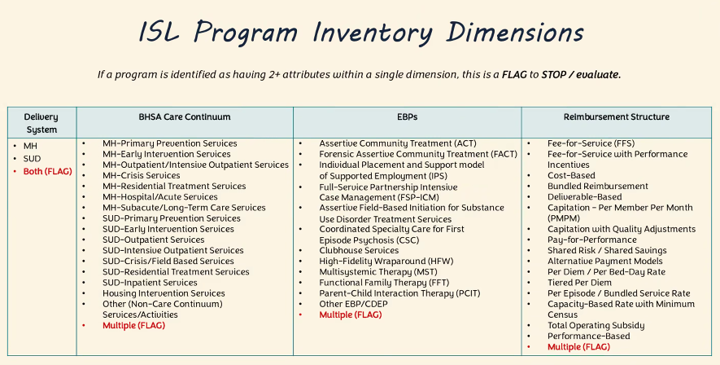
Programs will be incredibly important for ISL reporting. This is in part because of how DHCS requires ISL encounters to be reported and in part because of the limitations of procedure rate setup in SmartCare. For this reason, counties will need to review their programs and make sure that they do not have overlapping dimensions (see screenshot below). CalMHSA has provided a Program Inventory workbook for counties to use during their program review, and provided a training earlier this year. Training slides and resources can be found at Individual Service Level (ISL) – California Mental Health Services Authority. CalMHSA ISL Leads and ISL Coordinators are available for technical assistance.
Enhanced Program Mapping Webinar – UPCOMING
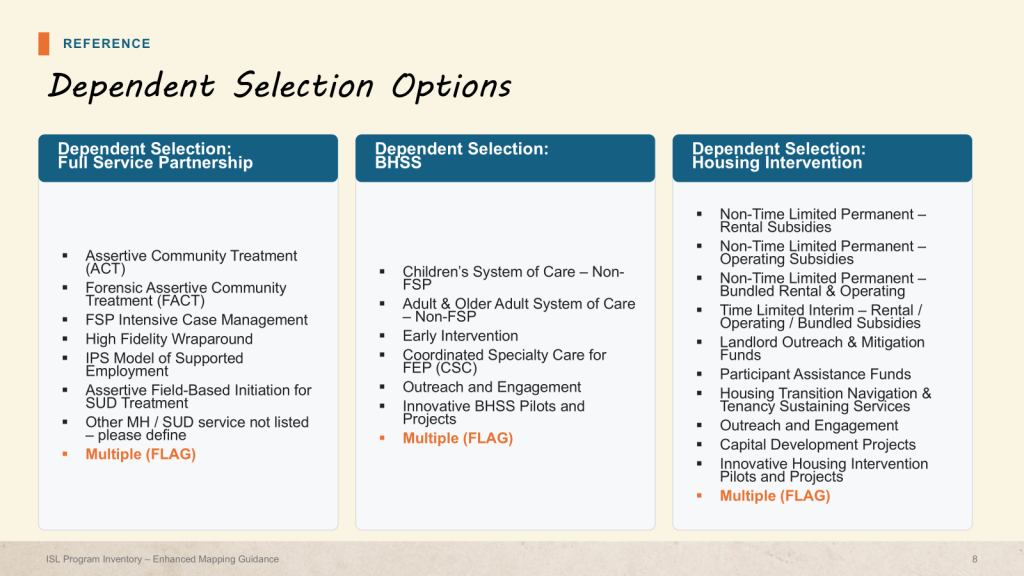
On September 18, 2026, CalMHSA will host an Enhanced Program Mapping Webinar. This webinar is designed for County and City Behavioral Health program, data, fiscal, BHSA, and EHR staff completing the enhanced Program Inventory Configuration Template designed by CalMHSA. Participants will learn how to complete the new BHSA Component and Dependent Selection fields, understand how the fields work together, and evaluate programs that span multiple components or service categories.
Through practical examples, the session will show counties how to flag and document complex or multipurpose programs, identify areas requiring further review, and use the enhanced mapping framework to support ISL implementation and anticipated BHOATR reporting (see screenshot below). Participants will also learn where to access ongoing technical assistance as they prepare for the January 1, 2027 ISL implementation date.
Custom Procedure Codes
As part of ISL readiness, counties should review their existing custom, non-billable client-specific procedure codes and determine whether they should be mapped to a standardized ISL code, retired, or identified as a potential gap in the DHCS ISL Code Library. Non-billable codes used for multiple services should also be reviewed to determine what they are capturing and mapped to the appropriate ISL code(s). See CalMHSA’s Non-Billable Code Review Considerations for ISL for additional guidance.
Trainings and Office Hours
CalMHSA will be putting on an initial training to go over the plan for ISL implementation in SmartCare. After the initial training, CalMHSA will be hosting ISL in SmartCare Office Hours every other week during implementation. These will be available for registration on the Events page.
SmartCare Configuration
CalMHSA is configuring SmartCare for ISL data capturing and reporting in the following ways.
Complete
- Add DHCS-approved ISL codes as procedure codes
- Added “ISL” prefix to all ISL codes, including existing procedure codes that will be used for ISL reporting
- Add ISL coverage plan template, which houses all the codes for the ISL extract, which will be used for ISL reporting
- This is currently inactive as we’re working toward implementation. No action from counties are needed.
- Counties will need to refresh their QA environments from Prod once this ISL coverage plan is created. Put in your request for refresh by 10/1/26 to ensure your QA environments are ready for ISL testing.
In progress
- Add rates to all ISL procedure codes
- Expense and day based ISL procedure codes will have a base rate set of $1 per unit.
Minute-based ISL procedure codes will use the per-minute rate for the practitioner’s assigned degree. If the practitioner rendering the service does not have a degree linked to their account, they must be set up with the ISL degree, and the Other Qualified Provider rate will be used.
- Will include changing ISL procedure codes from non-billable to billable
- Configuration of new BHSA Modifiers for counties not opted into BH-CONNECT
- These new modifiers will be required for ISL reporting and Medi-Cal claims. Please refer to the DHCS ISL Encounter Reporting Guidance.
Behavioral Health Plans are responsible for the following, these items can also be found in the ISL-BHP-Project-Plan-v2.xlsx. It is important that BHP’s open a ticket to refresh their QA instance for testing.
- Complete Program Inventory exercise (start/stop/continue)
- Develop plan for ISL data collection / EHR data entry
- Mechanism to get services into SmartCare
- Communicate to staff and contractors
- Examine current non-billable service codes and determine how to map to ISL codes, as applicable
- Update EHR programs, as needed (add new programs, modify existing programs)
- Assign ISL codes to EHR programs – if you’d like CalMHSA to do this for you, reach out to your CalMHSA account manager.
- Add EHR users, as appropriate
- Train on ISL data entry workflow, as appropriate
- Update provider contracts, as needed
- Update invoicing workflows, as needed
- Start collecting ISL data — officially required by DHCS starting 1/1/27 (start entering ISL services)
- Test ISL data extracts from EHR (not yet, requires development)
- Complete ISL Validation Test Plan (not yet, requires development)
Complete a test ISL submission in the DHCS portal (optional) — note: any data submitted between 7/1/26–12/31/26 is for DHCS testing only, not used for monitoring or public reporting (not yet, requires development)
Related Articles
Service Import into Practice Management (Batch Service Upload)
How to Add a Client’s Coverage Plan
How to Enter Client Services (via Service Detail screen – for non-clinical staff)
How to Write a Progress Note for an Unscheduled Service (via Service Note screen – for clinical staff)
How to Associate a User with Programs
How to Assign at Least One Clinical Data Access Group to a User
Additional Resources
CalMHSA:
ISL Resources for Counties – California Mental Health Services Authority
ISL Resources for Providers – California Mental Health Services Authority
For ISL questions, please submit an ISL ticket at this link: https://www.calmhsa.org/isl-ticket/
DHCS: